📄 Digital book in PDF · read it on your phone or print it
For Coastal Skipper / Yachtmaster Offshore shorebased theory. Three-point fixes, running fixes, tidal diamonds, course to steer, secondary port heights, IRPCS lights, IALA A buoyage and the Shipping Forecast. Each topic has its own page: the drawing first, then what you need to remember. 73 illustrated pages.
🔒 Secure checkout · PDF by email · 30-day guarantee
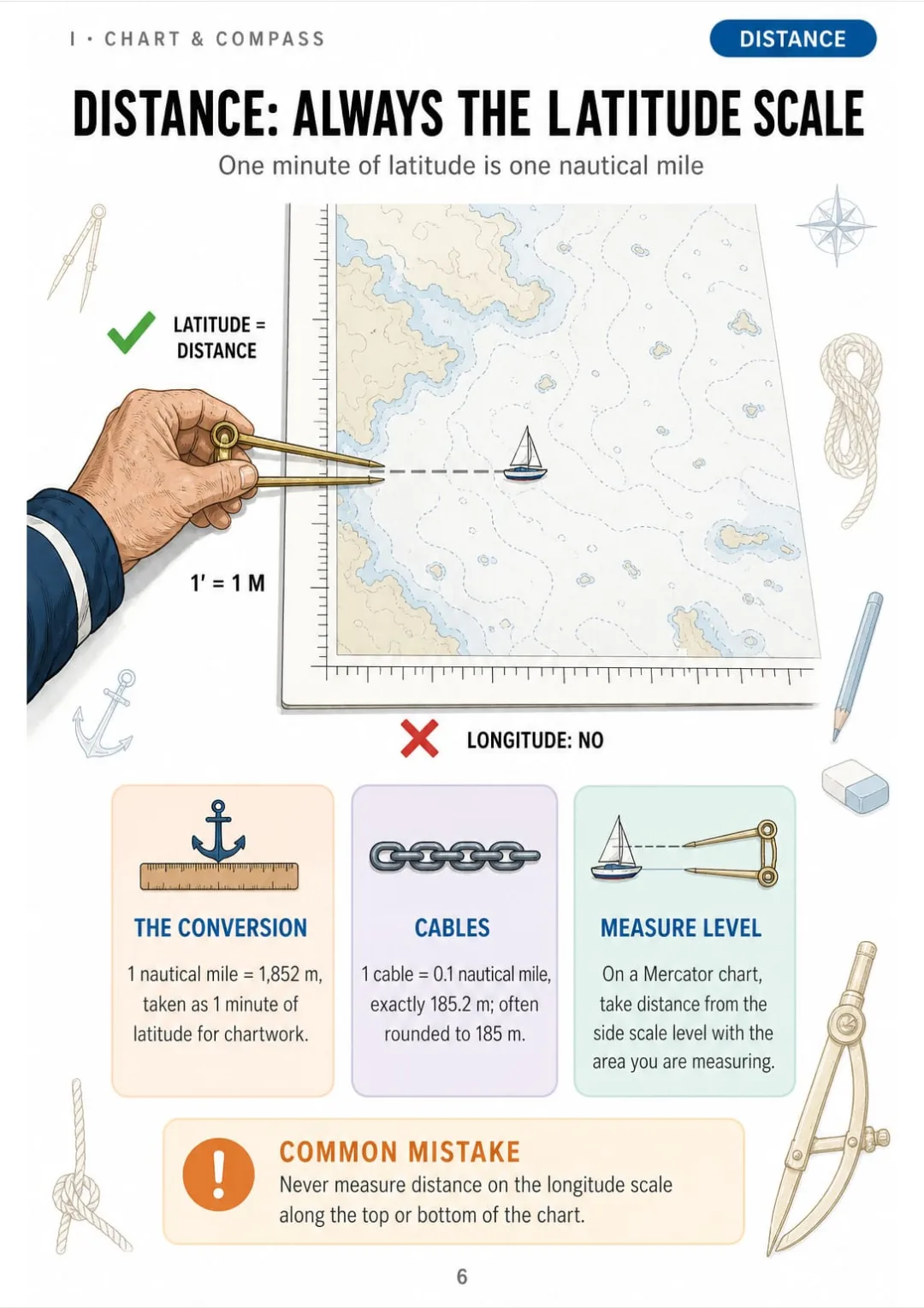
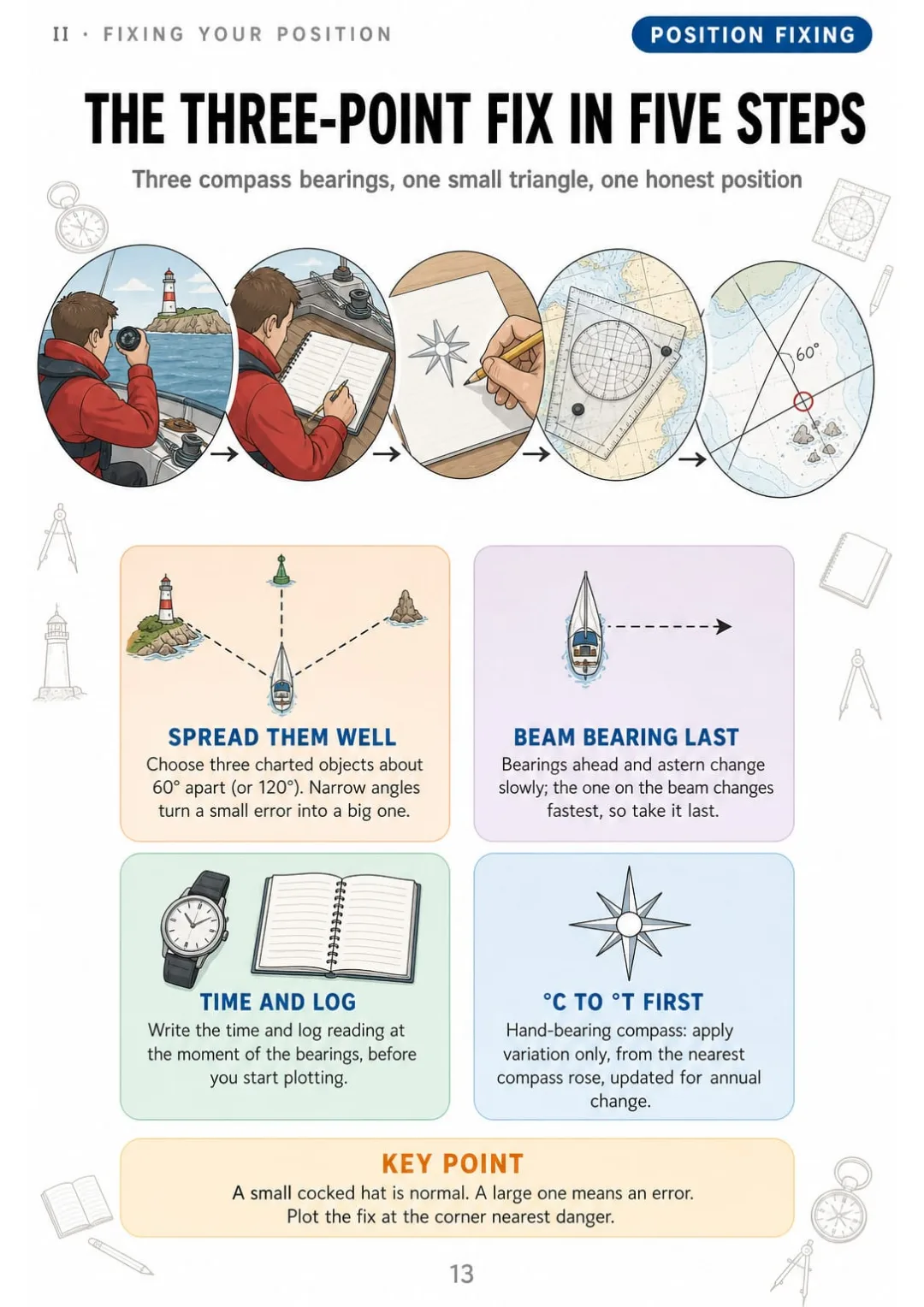
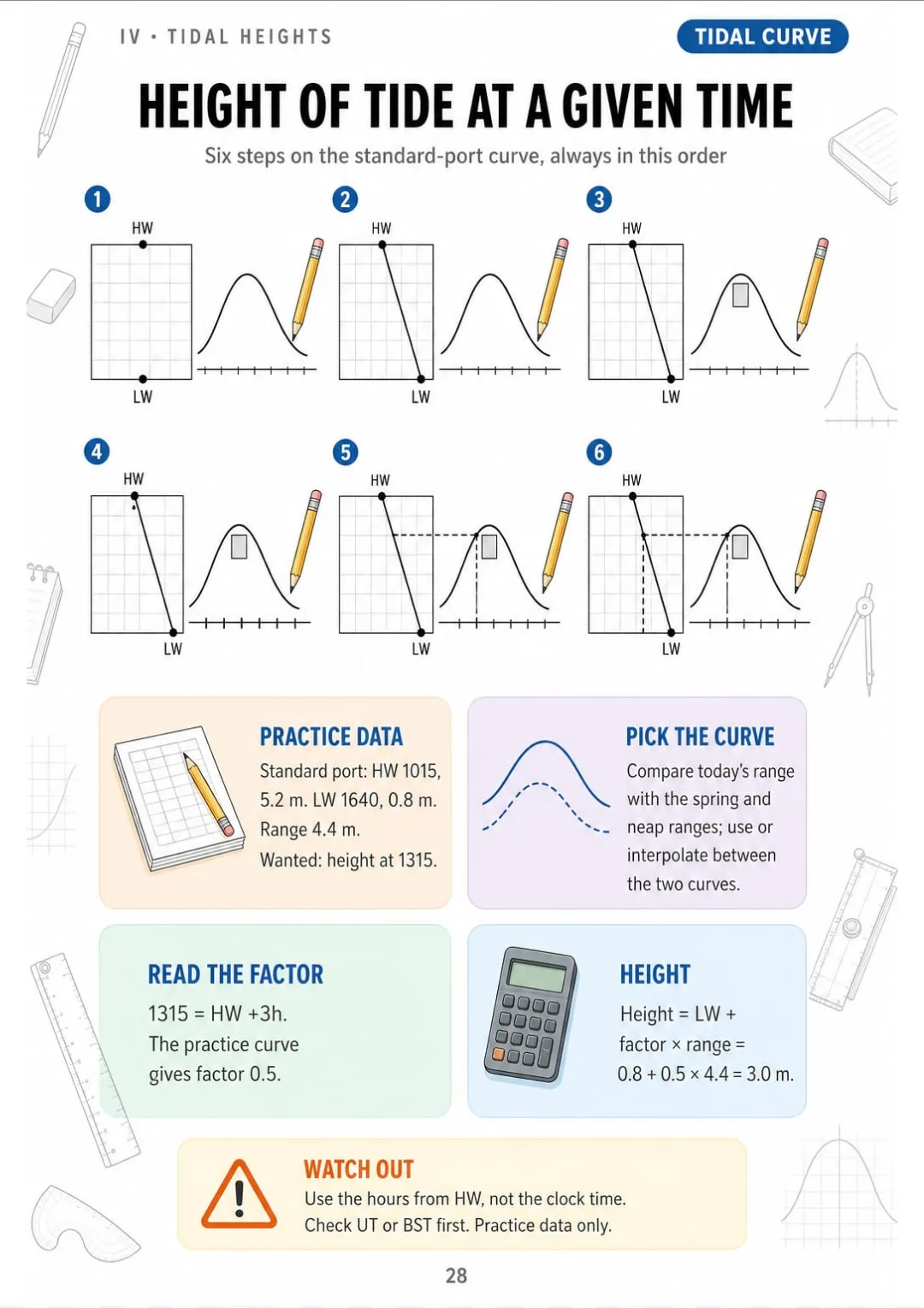
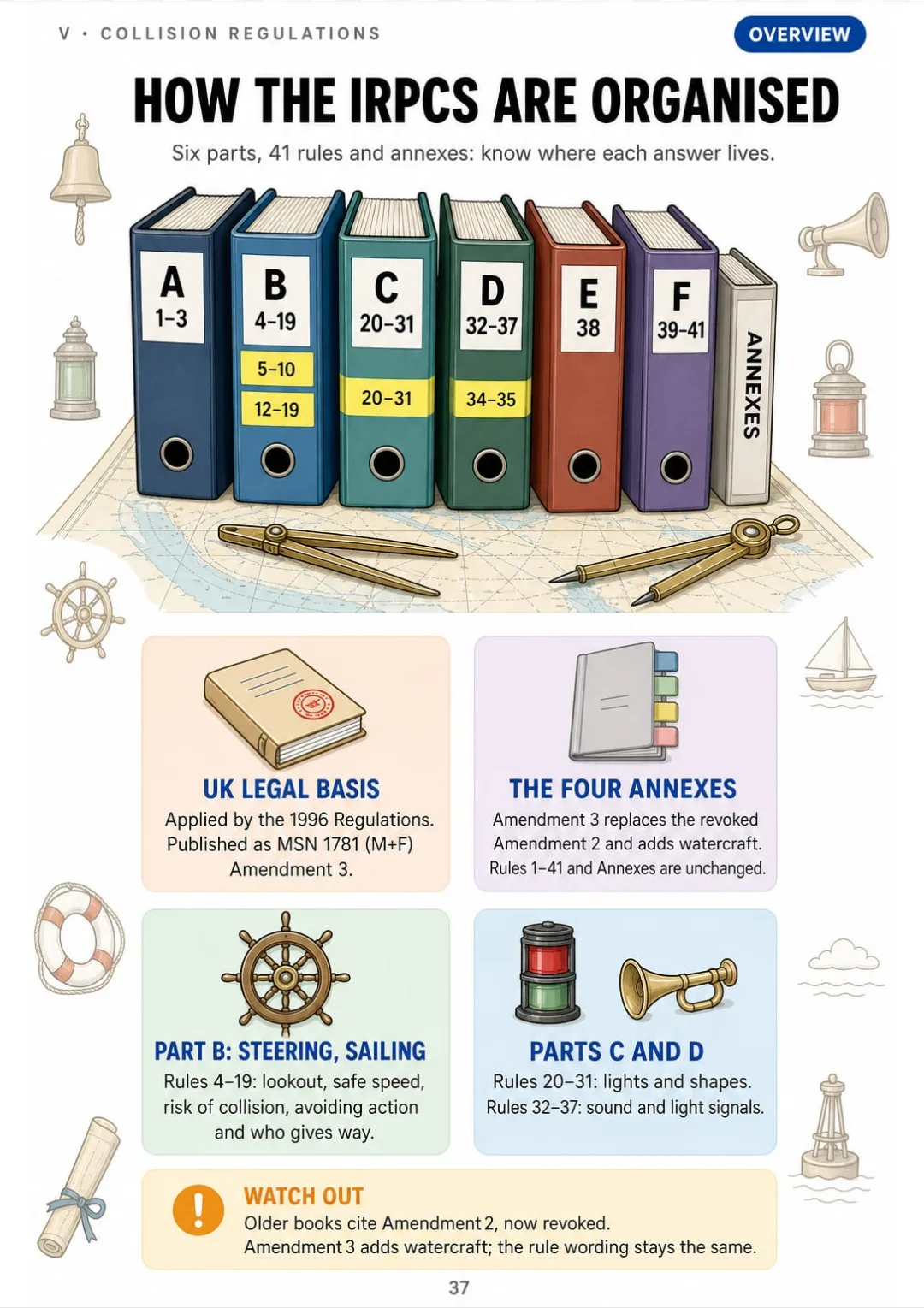
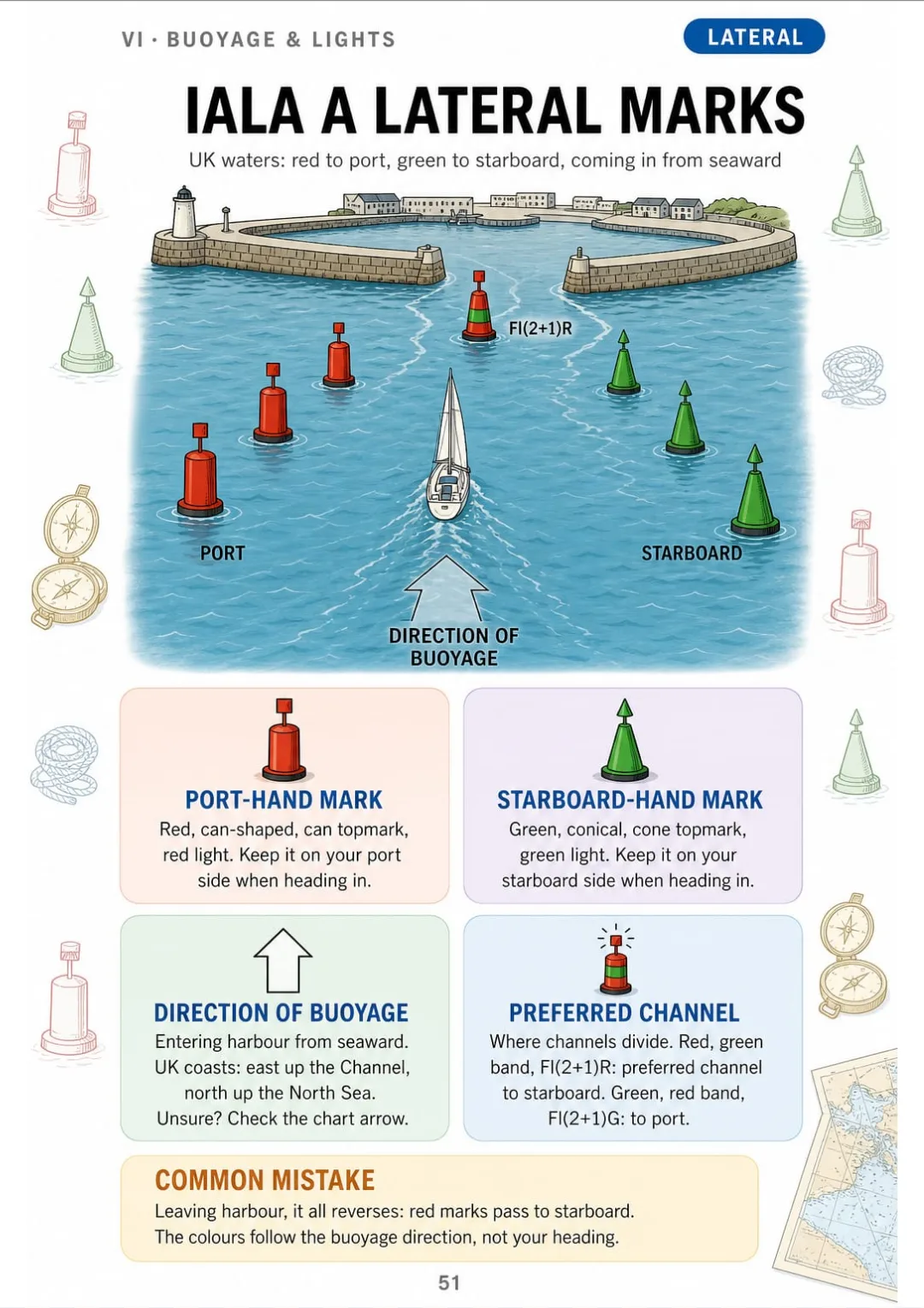
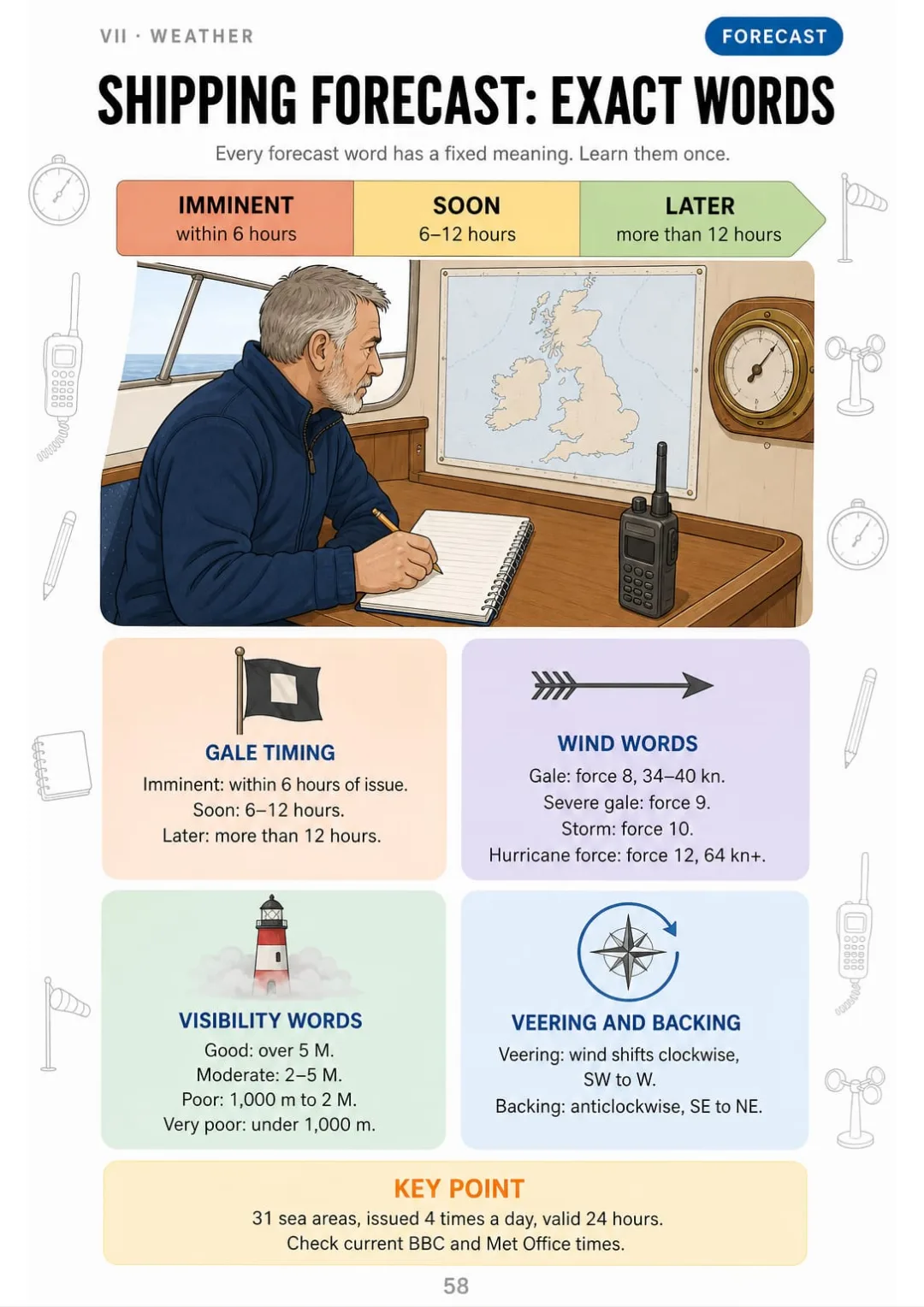
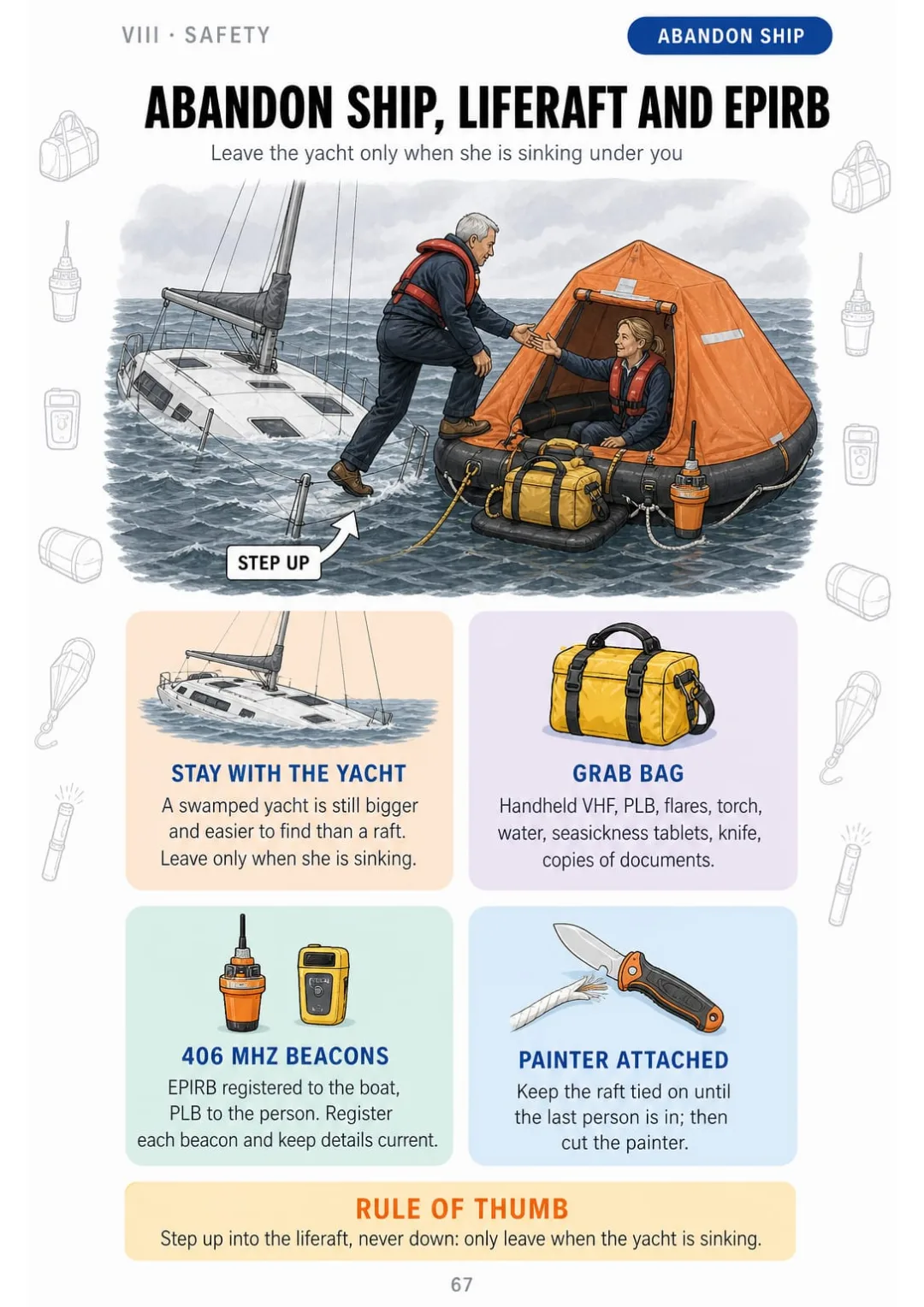
Every page has one large drawing and a box with the steps and numbers you need to know:


Swipe to see more →
These are real pages from the book. The table of contents is the full one: 9 parts and 68 topics.
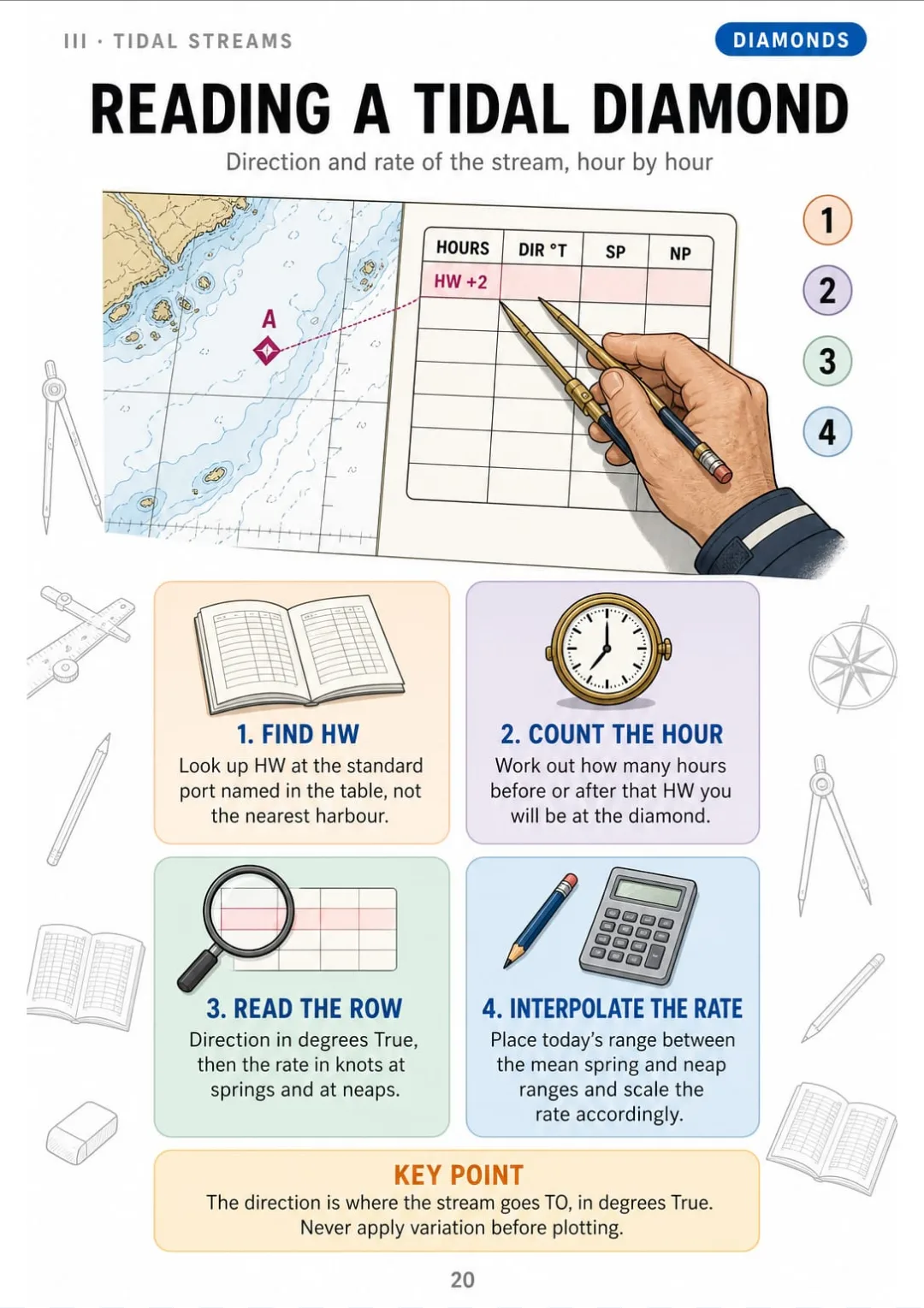
It's Tuesday evening, the practice chart is open and the question gives you tidal diamond C, two hours after HW at the standard port, springs. You're looking at a little table of numbers and you don't know which row to read.
The course notes explain it in one long paragraph: standard port, hours before and after, direction in degrees true, spring and neap rates, interpolate when you're in between. All correct, all in a block of text, and none of it on the chart.

In the book, the tidal diamond is one page. The table is drawn with an arrow to each part: HW at the standard port, the hour row, the direction in °T, the spring rate and the neap rate, then one worked example read across a single row.
Every other topic gets the same treatment: the three-point fix, course to steer in four steps, secondary port heights, the light arcs of the IRPCS, cardinal marks read like a clock.
You read the diamond, draw the tide vector and carry on, without going back to the notes to check which column was springs.

The chart and the compass, fixing your position, tidal streams and course to steer, tidal heights and secondary ports, the collision rules, buoyage and lights, weather and passage planning, safety and seamanship, and exam revision: 73 pages, all illustrated.
Think of it this way:
It's the exam paper, chartwork question: get from the harbour entrance to the waypoint in one hour, with the tide setting across your track. The clock is running and you need a course to steer.
You open the page on course to steer for one hour and see the triangle drawn on the chart: ground track, tide vector, boat-speed arc, water track, four steps in the order you'll use them.

Same with secondary port heights, the running fix, Rule 18, cardinal marks and the Shipping Forecast terms: each one on its own page.
Offshore Skipper Theory Illustrated is 9 parts and 68 topics, all drawn, and it ends with a revision section: the chartwork order and the tides order on one page each, plus a night lights self-test.
What you see drawn, you don't have to memorize.
Distance on the latitude scale, depths and heights, true-magnetic-compass, deviation, the six-minute rule, plotting symbols, GPS and chart datum.
The three-point fix, transits, DR vs EP, leeway, the running fix, rising and dipping lights, depth contours and radar ranges.
Tidal diamonds, the tidal stream atlas, course to steer for one hour and over several, ground speed and ETA, cross-Channel passages.
The tide vocabulary, standard port heights and times, the rule of twelfths, secondary ports from start to finish, the Solent curves, clearance under the keel and under a bridge.
How the IRPCS are organised, lookout and safe speed, Rules 12, 18 and 19, light arcs, every vessel's lights and shapes, sound signals.
IALA A lateral and cardinal marks, isolated danger and safe water marks, light characteristics, sectored and leading lights, clearing bearings, entering harbour at night.
Shipping Forecast terms, depressions and fronts, sea breezes and fog, wind against tide and tidal gates, passage planning, night watches and fatigue.
The safety brief, man overboard, VHF and DSC distress calls, liferaft and EPIRB, fire, flooding, helicopter rescue, engine checks and anchoring.
The chartwork order and the tides order on one page each, a night lights self-test and an exam-paper checklist.
At the end of the book: A revision section with the chartwork and tides order on one page each, a night lights self-test and an exam-paper checklist.

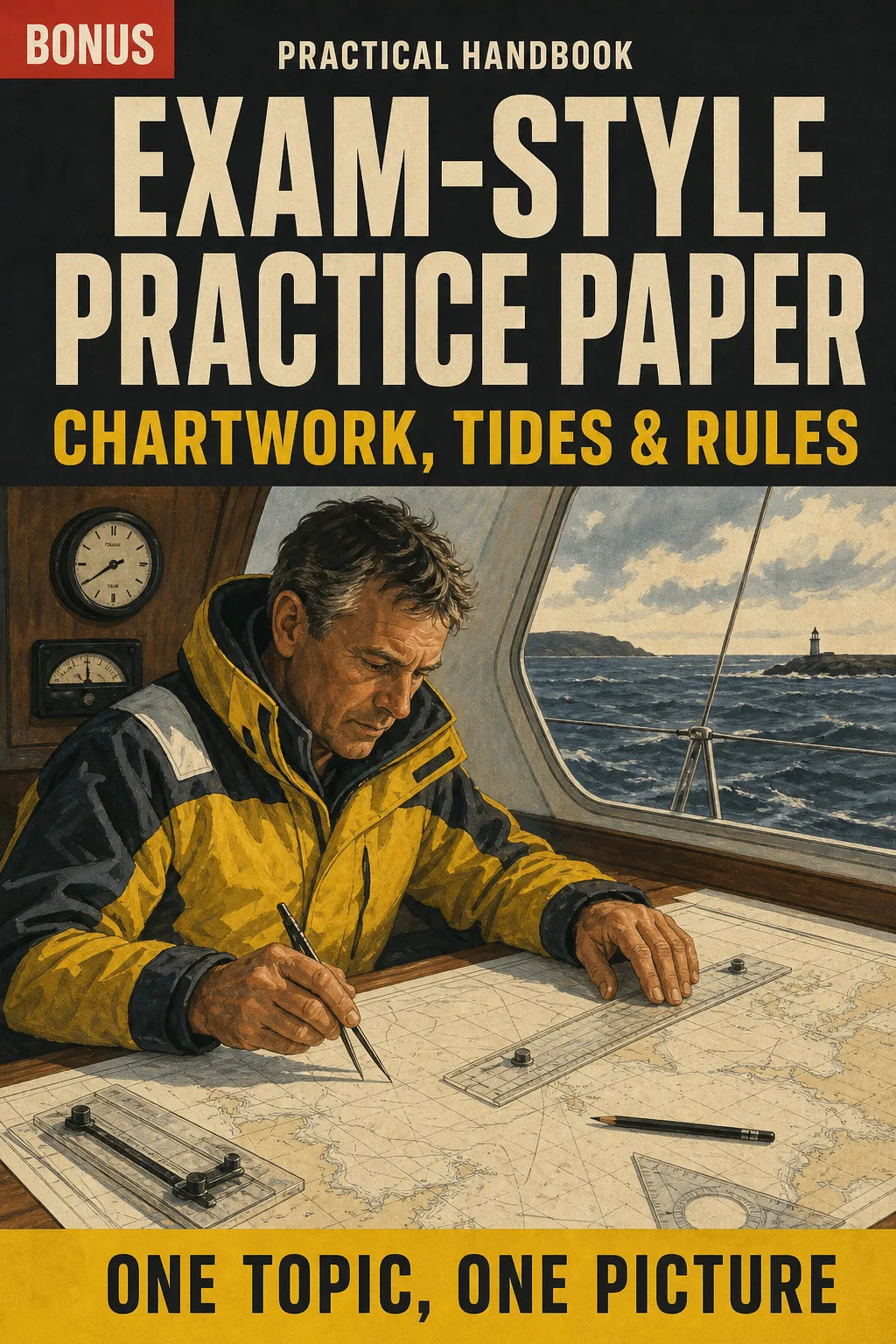
Exam-style questions with full worked answers, so you can practise course to steer, secondary ports and collision situations before the real paper.

The 15 most frequent slips in chartwork, tides and lights, each shown wrong and then right, so you spot them before the examiner does.
📄 This is a digital PDF book sent to your email: nothing is printed or shipped.
PDF by email: We email you Offshore Skipper Theory Illustrated as a PDF, together with the two free books. It's a single payment: no installments, no extra charges.
Each evening's topic has its own page to read before or after class: the drawing first, then the steps in the order the instructor will use them.
The revision part puts the chartwork order and the tides order on one page each, so you rework fixes, course to steer and secondary ports without hesitating.
Sail or power, print it and keep it at the chart table: lights, marks, forecast terms and the safety brief, ready to check at a glance on passage.
📄 This is a digital PDF book sent to your email: nothing is printed or shipped.
Try Offshore Skipper Theory Illustrated for 30 days, bonus books included.
We refund everything if the file won't open, if the book isn't what you see here, if you were charged twice or if the email doesn't arrive. Just email us.
You pay once. No subscriptions.
Yes. Part I runs quickly through the chart basics, then every page builds to the level of the theory syllabus: running fixes, course to steer over several hours, secondary ports, the full collision rules.
From the published Coastal Skipper / Yachtmaster Offshore shorebased theory syllabus, the IRPCS as applied in the UK by MCA MSN 1781, the IALA Region A buoyage system, UKHO chart symbols (Chart 5011) and Met Office Shipping Forecast terminology. UK conventions throughout: nautical miles, degrees true and magnetic, heights in metres above chart datum, tidal curves for standard and secondary ports, including the Solent. Tidal data in the examples are practice data, not for navigation.
No. It's an independent study guide, not affiliated with or endorsed by the RYA, the MCA or the UKHO. It doesn't give a certificate: your qualification comes from your recognised course and exam.
No. Keep your course notes and your almanac: they give you the text and the tables. This gives you each calculation drawn on the chart, with the steps in the order you use them, one topic per page, to revise before class and keep at the chart table.
No. They're written for this book, in exam style, with full worked answers. They aren't official exam questions.
The book and the two gifts arrive as PDFs by email, to the address you enter at checkout.
No. It's a one-off payment.
It's a PDF, not a printed book: it arrives by email and you print it yourself, at home or at a print shop. The layout uses short sentences and large type, made to sit on the chart table.
You have 30 days. We refund everything if the file won't open, if the book isn't what you see on this page, if you were charged twice or if the email doesn't arrive: just email us.
No more rereading the notes with nothing sticking.
A secondary port height, drawn on the curve, and done.
You walk into the exam knowing where everything is.
Drawings make studying faster.
The book is right below.
One-time payment: US$ 27 · Guarantee: 30 days · PDF by email
YES, I WANT OFFSHORE SKIPPER THEORY ILLUSTRATED FOR US$ 27📄 This is a digital PDF book sent to your email: nothing is printed or shipped.